
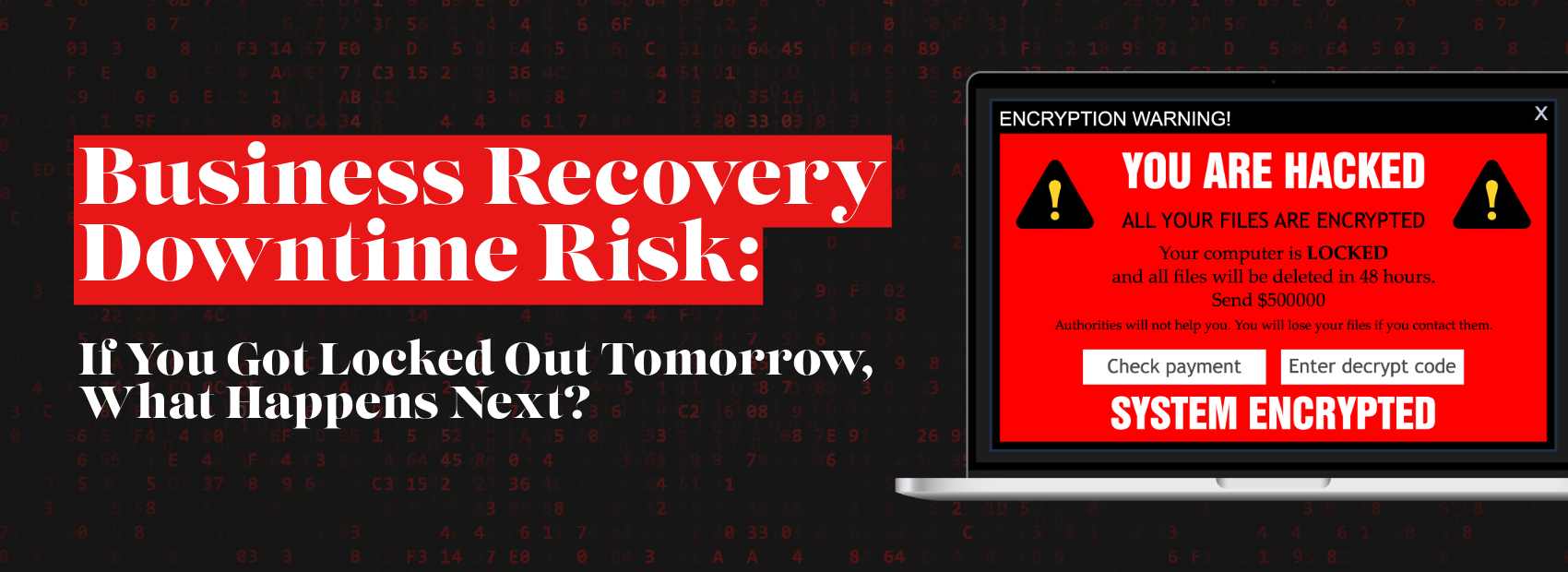
Business recovery risk is one of the most overlooked threats facing small and medium businesses today. While many organizations believe they are protected, few truly understand how quickly they could recover from a real disruption.
Moreover, the question is not if something will happen. Instead, it is when and how prepared you are when it does. Whether it is ransomware, accidental deletion, or system failure, the ability to recover quickly determines the true impact on your business.
So, before assuming everything is covered, it is worth asking a simple question: If your business stopped right now, how long would it take to get back online?
Backups Don’t Mean You’re Safe
Many SMBs take comfort in knowing they have backups in place. However, backups alone do not equal recovery.
In fact, backups are only one piece of the equation. While they ensure data exists somewhere, they do not guarantee fast restoration, system functionality, or operational continuity.
For example, restoring files from a backup may take hours or even days. During that time, your team cannot access systems, serve customers, or generate revenue.
Additionally, backups often exclude critical components such as SaaS applications, identity systems, and configurations. As a result, even with data intact, the business remains offline.
The takeaway: Backups protect data. Recovery protects your business.
The Real Cost of Downtime for SMBs
Downtime is not just an IT problem. It is a business problem with direct financial consequences.
First, there is the immediate loss of productivity. Employees are unable to perform their roles, which creates a ripple effect across the organization.
Second, revenue stops. Whether you rely on transactions, service delivery, or client communication, downtime halts income generation.
Third, customer trust takes a hit. Clients expect reliability, and disruptions can damage your reputation long after systems are restored.
According to IBM, the average cost of a data breach continues to rise, highlighting the importance of preparation and rapid recovery.
In short, downtime impacts far more than systems; it affects your entire business operation.
Where Most SMB Recovery Plans Fall Short
Even businesses that invest in IT often have gaps in their recovery strategy. These gaps are not always obvious until a real event occurs.
1. No Defined Recovery Time Objective (RTO)
Many organizations cannot answer how long recovery should take. Without a defined target, recovery becomes unpredictable and often too slow.
2. Missing Recovery Point Objective (RPO)
How much data can you afford to lose? Without this clarity, businesses risk restoring outdated or incomplete information.
3. SaaS and Cloud Blind Spots
Many assume cloud platforms automatically handle recovery. However, services like Microsoft 365 operate on a shared responsibility model.
This means your data may still require additional protection and recovery planning.
4. Identity and Access Failures
If users cannot log in, your business cannot operate. Identity systems are often overlooked in recovery planning, yet they are critical to access.
5. No Real Testing of Recovery Plans
Perhaps the biggest gap is the lack of testing. A plan that has never been tested is simply an assumption, not a strategy.
What a Real Business Recovery Strategy Looks Like
To reduce the risk of business recovery downtime, SMBs must move beyond basic protection and toward full operational readiness.
Define Clear Recovery Objectives
Start by establishing realistic RTO and RPO targets. These benchmarks guide your strategy and ensure alignment with business needs.
Protect More Than Just Data
Include systems, applications, configurations, and identity platforms in your recovery plan. The goal is to restore operations, not just files.
Implement Layered Safeguards
Use a combination of backups, replication, and security controls to create multiple recovery paths. This reduces dependency on a single solution.
Test and Validate Regularly
Run recovery simulations to identify gaps and improve response times. Testing builds confidence and ensures readiness when it matters most.
Align IT with Business Impact
Finally, tie recovery planning to business priorities. Focus on what must come back online first to minimize disruption.
The Shift from IT Protection to Business Resilience
The most successful SMBs no longer think in terms of IT protection alone. Instead, they focus on business resilience.
This shift changes the conversation from “Do we have backups?” to “Can we continue operating under pressure?”
Organizations that adopt this mindset are better prepared to handle disruptions, maintain customer trust, and recover faster than their competitors.
Ultimately, resilience is not about avoiding problems. It is about responding effectively when they occur.
Know Your Risk Before It Becomes Reality
Business recovery downtime risk is not something you want to evaluate during a crisis. By then, it is too late to fix the gaps.
Instead, proactive assessment allows you to identify weaknesses, prioritize improvements, and build confidence in your recovery strategy.
At Atom Creek, we help organizations understand their true exposure, align technology with business outcomes, and build strategies that support long-term resilience.
If you are unsure how quickly your business could recover, now is the time to find out.
AEO FAQ: Business Recovery Downtime Risk Explained
Q: What is business recovery risk?
A: Business recovery downtime risk refers to the potential financial and operational impact of how long a business takes to recover from an IT disruption.
Q: Why are backups not enough for recovery?
A: Backups store data, but they do not ensure fast restoration or full system functionality. Recovery requires a broader strategy that includes systems and access.
Q: What is the difference between RTO and RPO?
A: RTO defines how quickly systems must be restored, while RPO defines how much data loss is acceptable during recovery.
Q: How can SMBs reduce downtime risk?
A: SMBs can reduce downtime risk by defining recovery objectives, implementing layered protection, testing plans regularly, and aligning IT with business priorities.